
ANVITA’s “Welcoming Mayors” Action Plan
ANVITA (L’Association Nationale
des Villes et Territoires Accueillants)
Co-Chairs
Damien Carême and Jeanne Barseghian
Start of Project
September 2024
End of Project
February 2026
Overview
ANVITA’s “Welcoming Mayors” action plan aims to equip local governments to address the rise of hate speech and misinformation in the run-up to the 2026 municipal elections. In a context marked by the rise of the far right and ideological offensives such as the “Pericles Project,” its goal was to defend unconditional hospitality and human rights at the local level.
The program was structured around five complementary pillars:
A series of webinars (“Les RDV des Municipales”) dedicated to analyzing public opinion, media strategies, and online hate.
A “School for Welcoming Mayors” offering training to support the fight against the far right, combining legal and communication-based responses.
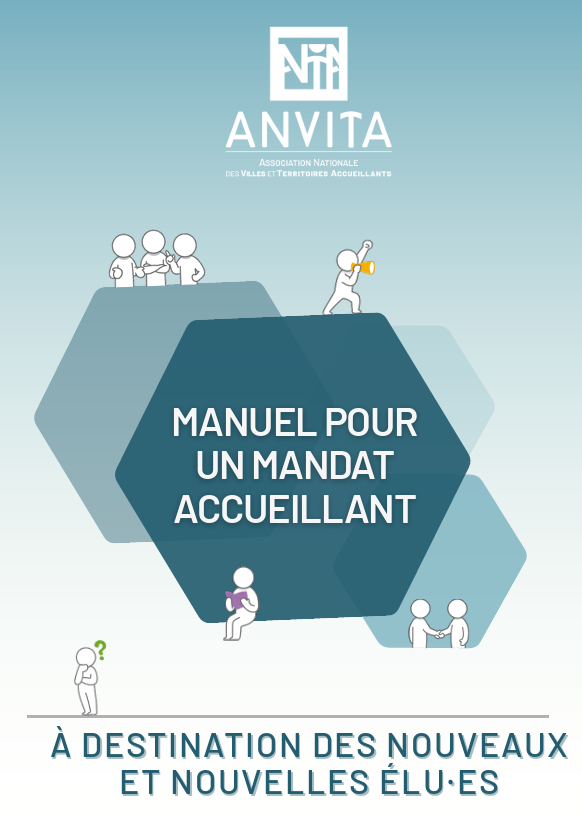
The publication of a “Manual for a Welcoming Term” intended for future elected officials for the 2026–2033 term.
A weekly news watch via a WhatsApp group to identify and counter hateful disinformation targeting the rights of exiled people.
Finally, the organization of political and festive events in several regions to promote a positive counter-narrative on migration.
Achieved Impact
The “Maires Accueillantes” initiative has tangibly strengthened local governments’ resilience and ability to respond to hate speech and misinformation. Its impact is felt on several complementary levels:
First, a significant increase in skills: more than 140 elected officials and staff members from over 18 regions (Paris, Grenoble, Villeurbanne, Hendaye, etc.) have been trained through the ALED module. - These trainings have facilitated the shift from a defensive stance to mastery of legal and communication tools.
Second, the production of tools such as the “Manual for an Inclusive Term of Office” has helped anchor the initiative for the long term and serves as a foundational resource for municipal teams during the 2026–2033 term.
The program has also consolidated an active and responsive network: over 220 members receive the weekly update via WhatsApp, while the webinars have widely engaged local governments.
Public initiatives, notably the “Let’s Demand a Welcoming France” events, have helped bring discourses on hospitality back into the public sphere.
The evaluation of the plan is based on specific quantitative indicators (participation in training sessions and webinars, number of regions involved, number of opinion pieces signed), supplemented by regular progress reports. On the qualitative side, the feedback gathered during the 2025 Political Meetings on Reception helped validate the relevance of the tools and the usefulness of the dissemination mechanisms.
Lessons Learned
The completion of the action plan has yielded several key lessons for strengthening the effectiveness of local welcoming policies.
ALED training sessions have shown that legal support and practical communication tools enable local elected officials to stop being on the defensive and to regain the upper hand against organized rhetoric and strategies.
Furthermore, it is important to reach beyond one’s own circle: by combining political statements with festive or cultural events, local communities have succeeded in reaching a wider audience and making messages of hospitality more visible and accessible.
The initiative also demonstrated the value of drawing on diverse data and expertise. Collaborating with researchers, journalists, and community organizations for webinars helped strengthen the credibility of messages and better counter misinformation.
Opportunities for dialogue helped break the isolation of certain areas, particularly rural ones, and fostered lasting connections among stakeholders.
Finally, two tools proved particularly effective: proactive monitoring, thanks to the news feed shared on WhatsApp, and collective legal action, which serves as a concrete lever for changing government practices.
Priority Objectives

Realizing socio-economic inclusion

Eliminating all forms of discrimination and promoting evidence-based public discourse

Engaging in regional and multilateral partnerships and increasing city-to-city cooperation


“As far-right ideas have infiltrated decision-making circles, the media, and pseudo-scientific forums, we have worked to educate, inform, and empower people, to deconstruct their rhetoric, and to create spaces for us to come together. We are far from alone, witnessing a surge of solidarity and civic engagement. We rejoice in this, just as we welcome this strong mobilization of civil society.”