
Supporting Local and Regional Authorities to Identify Migration Governance Needs and Advance Evidence-Based Policy Solutions through IOM’s Migration Governance Indicators
International Organization for Migration - Migration Governance Indicators
Start of Project
Ongoing
End of Project
Ongoing
Overview
IOM, through the Migration Governance Indicators (MGI), commits to local and regional authorities, upon request, to use the MGI to identify migration governance needs and advance evidence-based policy solutions.
IOM, through the Migration Governance Indicators (MGI), commits to local and regional authorities, upon request, to use the MGI to identify migration governance needs and advance evidence-based policy solutions.
The Migration Governance Indicators (MGI) supports governments in providing a comprehensive review of migration governance frameworks at national or local level. The tool enables authorities to take stock of existing policies, institutional arrangements and coordination mechanisms, while identifying strengths and needs, for further development.
The process is voluntary, consultative and government-led, and is tailored to national and local contexts. It is designed to foster constructive dialogue with relevant authorities and stakeholders, supporting governments in policy priorities and identifying practical evidence-based policy solutions.
In an effort to support the formulation of well-managed local policies and discussions through a Whole-of-Government approach on migration governance, IOM introduced the Migration Governance Indicators (MGI) at the local level. This tool offers local authorities an opportunity to have an introspective look at the policies, programmes and structures in place to manage migration.
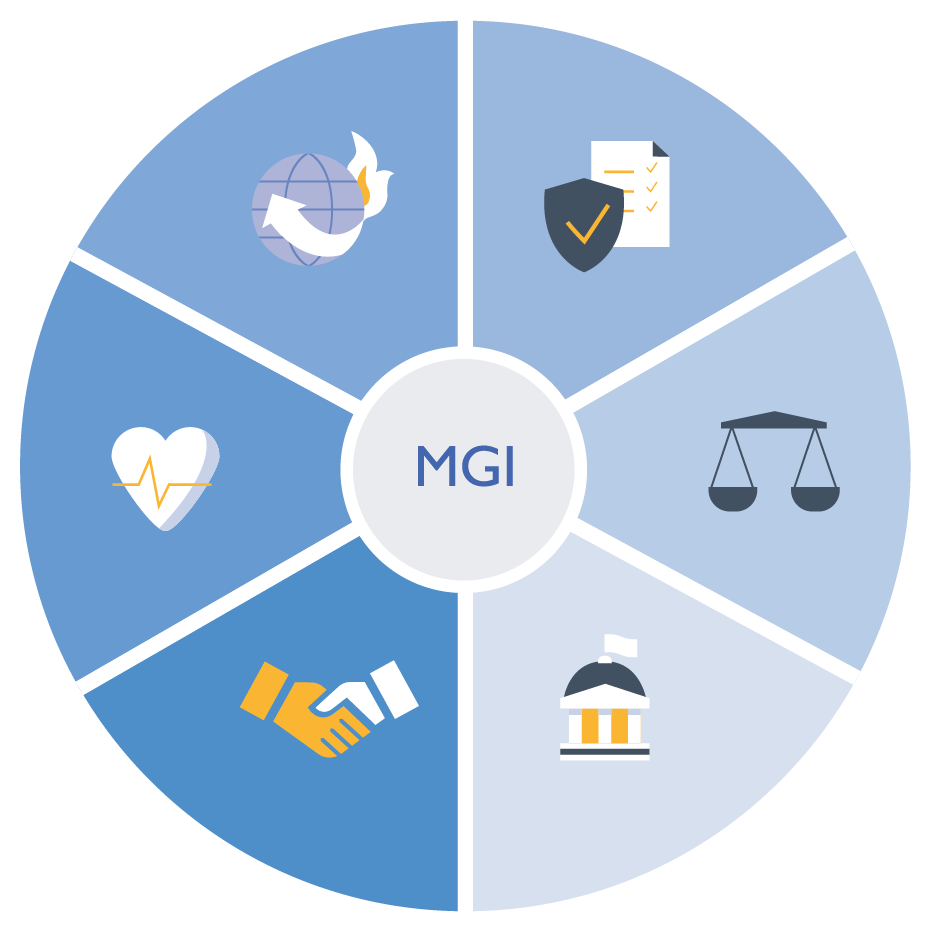
The nearly 70 indicators for local MGIs and 100 for nationals cover six dimensions of migration governance: migrant rights, whole-of-government approach, partnerships, well-being of migrants, mobility dimension of crises, and safe, orderly and regular migration.
Expected and Achieved Impact
The MGIs have been a key initiative in helping local governments progressively strengthen their migration management systems. Upon government request, the MGI process enables local authorities to take stock of their existing migration policies and strategies, identify good practices as well as areas with potential for further development. The examples below illustrate how the MGI has contributed to enhancing local migration governance from different angles:
The municipal government of Upala, Costa Rica, developed its Human Mobility Policy (2024-2034) with strong emphasis on labour migration, which is one of the priority areas identified in the MGI assessment. The Policy includes actions such as sensitizing employers to incorporate foreigners with regular migratory status into the labour market and providing counselling so that foreigners can access the services of the National Employment Agency, with the aim of improving labour migration management and expanding regular pathways for migrant workers.
In Kenya, the MGI processes in Nairobi and Mombasa have significantly enhanced the collaboration among the national and local governments on migration governance. A standout achievement is the establishment of local migration coordination platforms in both municipalities, facilitated by the National Coordination Mechanism on Migration and IOM Kenya. These platforms have successfully identified key migration priorities, leading to the development of a robust workplan for enhanced coordination and increased resource allocation.
In the city of Balti, Republic of Moldova, since 2023, 700 children have benefited from the sports hall renovated by IOM and the local government to address gaps identified by the MGI process. This facility serves as a safe and inclusive space for Ukrainian and Moldovan students in the community, and it contributes to social cohesion by fostering a sense of belonging through joint participation in sports activities, such as basketball, volleyball, gymnastics, and training for local and national competitions.
Lessons Learned
A first positive lesson is the clear and growing demand from local governments to conduct an MGI (106 local assessments so far), which demonstrates the relevance of the assessment and a strong commitment from local authorities to improving local migration governance.
Secondly, conducting multiple Local MGIs within the same country has shown that the process can contribute, at some level, to vertical and horizontal coordination. This happens since the assessments can foster constructive dialogue between national and local authorities as well as create opportunities for local government officials to learn from one another when sharing their own challenges and evidence-based solutions related to migration management.
A third key lesson relates to the value of combining MGI data with other data sources. When integrated with other initiatives, such as the Displacement Tracking Matrix (DTM), the joint analysis provides a more comprehensive picture of how policies operate in practice and how they align, or could better align, with the needs of migrant populations. This robust analysis provides local authorities with better understanding the implications of their policy frameworks and design more targeted interventions to improve orderly and regular migration (an example can be found here).
Priority Objectives

Improve migration governance and forced displacement protection

Providing access to urban infrastructure, social services, and education regardless of status

Eliminating all forms of discrimination and promoting evidence-based public discourse