
ANVITA’s 2026 Summary Guide: “Toward a Welcoming France”
ANVITA (L’Association Nationale
des Villes et Territoires Accueillants)
Co-Chairs
Damien Carême and Jeanne Barseghian
Start of Project
January 2026
End of Project
January 2027
Overview
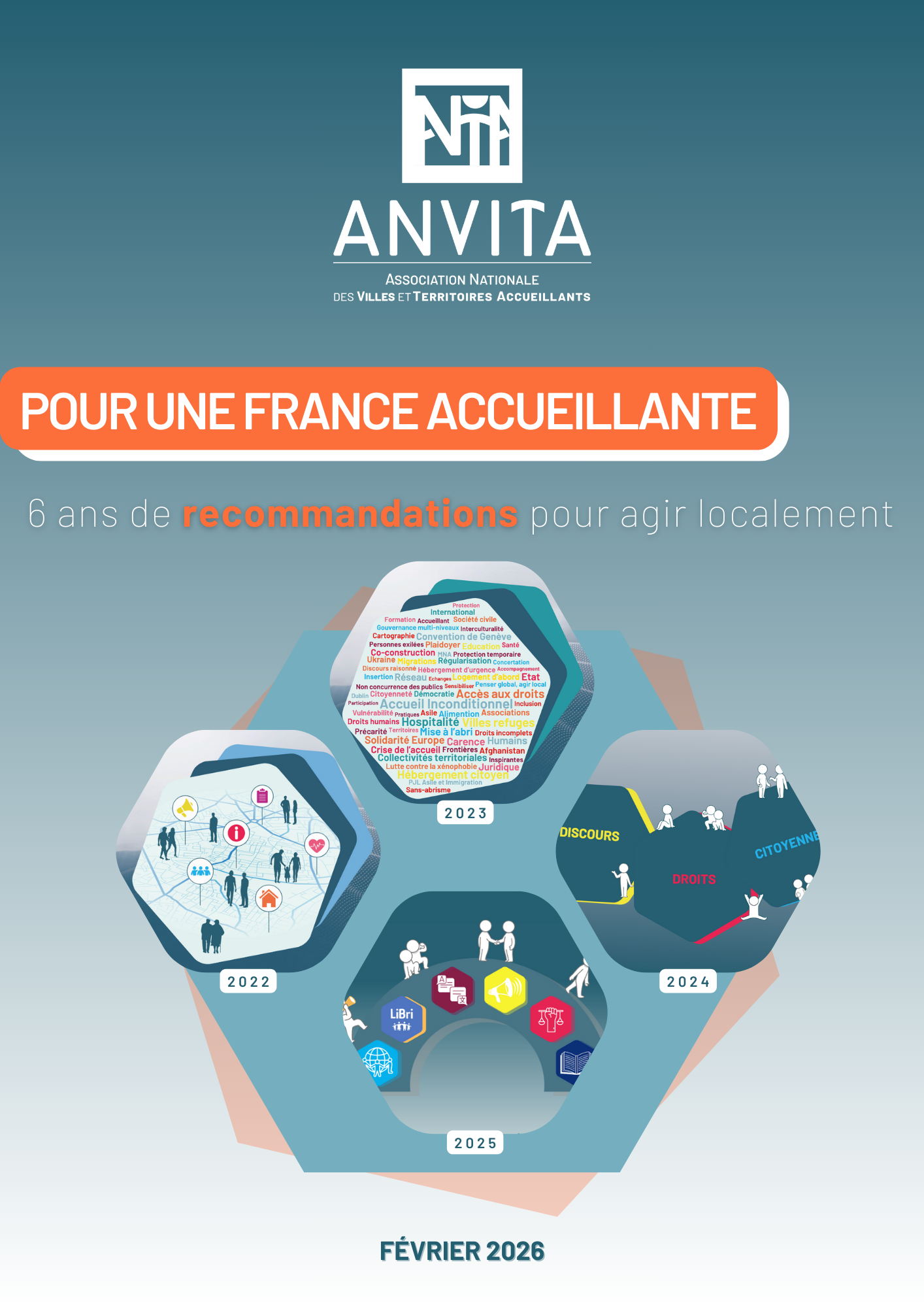
Published on February 11, 2026, this summary report is the culmination of six years of gathering inspiring practices within the ANVITA network and a synthesis of the four guides released annually since 2022. It serves as the “what to do” reference framework for local reception policies, complementing the 2025 handbook For a Welcoming Mandate, which focuses on the “how to do it.”
The goal is to provide candidates for the 2026 municipal elections and future elected officials with a strategic toolkit for building welcoming communities. The guide is structured around three fundamental pillars: promoting an alternative vision of migration (counter-narrative), fostering unconditional access to rights (health, housing, education, etc.), and fostering inclusive local citizenship (participation, sports, and culture).
This document draws on more than 2,000 practices collected from 90 member municipalities and aims to transform unconditional welcome into concrete, sustainable, and cross-cutting public policies.
Expected Impact
The initiative first made it possible to synthesize and organize several years of monitoring and the collection of inspiring practices from ANVITA regions. This document thus provides a solid foundation for promoting these practices and contributes to advocacy for welcoming local policies.
Furthermore, the guide aims to support candidates in the March 2026 municipal elections by helping them more easily integrate these issues into their platforms. It could also help advance the local public debate.
This guide may encourage new local executives to develop certain mechanisms and methods for interdepartmental cooperation. In this way, it promotes a cross-sectoral approach to welcoming, mobilizing multiple public policies.
This summary is the culmination of four previous guides, whose quantitative impact can already be demonstrated:
2022 Edition: +250 practices collected; +30 local authorities reached; +1 partnership with the CCFD Terre Solidaire association to create a version tailored to their volunteer groups.
2023 Edition: +300 practices collected; +80 local authorities reached; +600 people reached.
2024 Edition: +500 best practices collected.
2025 Edition: +500 best practices identified; +90 regions mentioned; +300 copies distributed to +100 local authorities; +1 partnership with Oxfam to create a version tailored to their target audiences.
The evaluation will be based on quantitative factors (distribution of the guide, number of local governments cited, number of local governments reached, initiatives inspired) and qualitative factors, through feedback from elected officials and on-the-ground stakeholders, as well as through the concrete implementation of new measures inspired by the guide.
Lessons Learned
The preparation of this summary has highlighted several key lessons.
This guide demonstrates that, while the national government sets the general framework, local governments play a decisive role in day-to-day operations. Mayors have concrete tools at their disposal—such as residency registration, sliding-scale fees, and participatory forums—that enable them to take direct action and improve living conditions, regardless of national policy changes.
Furthermore, sharing concrete experiences—including the challenges encountered—creates a genuine space for exchange and inspiration among regions.
Furthermore, local action reveals its limitations when carried out in a fragmented manner. An effective reception policy must integrate several dimensions: work on perceptions (counter-narratives), access to rights (health, education, housing), and citizen participation. If any of these aspects is neglected, the entire approach is undermined.
Another important lesson is the need to work differently, in a more cross-cutting and open manner. Experience shows that involving those directly affected from the very conception of initiatives allows for a better response to real needs and enhances their effectiveness.
Priority Objectives

Eliminating all forms of discrimination and promoting evidence-based public discourse

Supporting reception and advancing community sponsorship initiatives

Engaging in regional and multilateral partnerships and increasing city-to-city cooperation


“Fighting the far right—everywhere, all the time—is not just a matter for a specific marginalized group; it concerns us all. It means defending the public interest, social cohesion, and the ability to live together harmoniously in our communities. This is at the heart of the local policies championed by communities committed to unconditional acceptance.”