
Urban Climate Migration: Challenges, Representations, and Inclusion
City of Paris
Mayor
Anne Hidalgo
Start of Project
01/01/2022
End of Project
12/31/2022
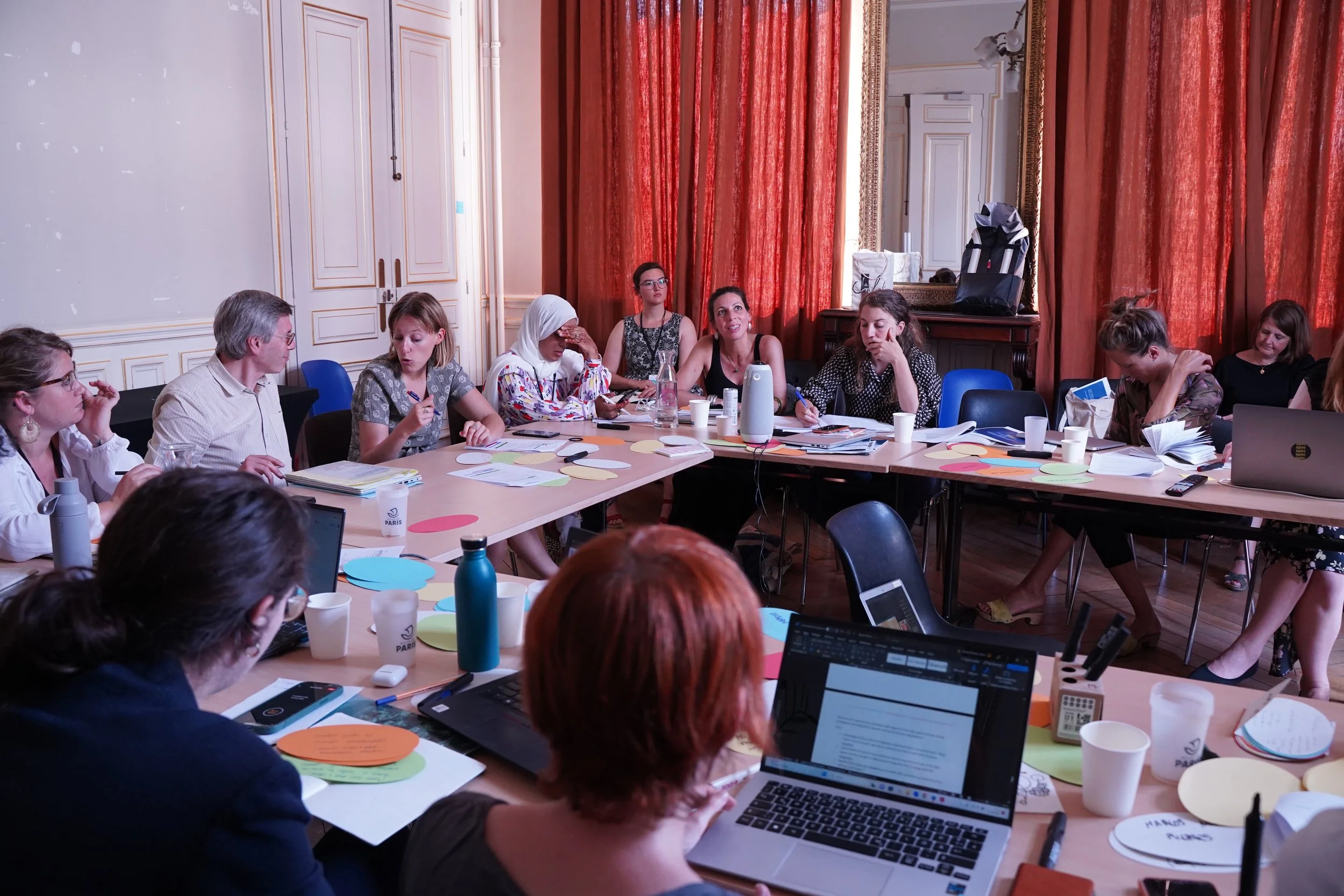
© UCLG-CGLU/ 27 June 2023 Workshop with the City of Paris on how to implement local climate adaptation promoting migrant- and refugee-inclusion
Overview
Through its “Prospective Study on Climate-Induced Migration”, the City of Paris pledged to understand and address the links between climate change, mobility, and urban inclusion. Implemented in partnership with the International Organization for Migration (IOM) and the Hugo Observatory (University of Liège), the pledge aimed to strengthen Paris’s knowledge base, integrate migration and climate resilience into municipal planning, and inform the city’s 2024–2030 Climate Plan and Resilience Strategy.
This project seeks to support cities in better understanding and addressing the impacts of climate change on migration to and from urban areas in their urban planning efforts and in their climate, reception, and integration policies for migrants and displaced persons. The project is part of growing international initiatives, such as those of the Mayors Migration Council (MMC) and the C40 Cities Climate Leadership Group, to guide and accelerate local, national, regional, and global responses to climate change and migration in cities, and to support local actors in developing inclusive urban policies.
The project has three main objectives:
To improve the available knowledge on the impact of climate change on migration to and from cities.
To foster the exchange of good practices and experiences between cities.
To support cities in developing inclusive urban policies, towards a fair and sustainable ecological transition.
Expected Impact
The project sought to provide the City of Paris with the necessary tools to better understand how climate change will influence migration dynamics on its territory, and to prepare for these changes.
The impact of the project was to be measured by taking into account the recommendations and courses of action formulated within the project’s framework, to include considerations relating to migration induced by climate change in the City of Paris' climate and adaptation policies. The impact was also to be measured by the establishment of a dialogue between Paris and other cities around the world willing to promote ambitious action to address the challenges of climate change and migration in cities, and by the participation of Paris in initiatives and networks of cities active on these issues. The impact of this IOM-led project would ultimately be measured by its ability to be scaled up and replicated in other cities, with Paris as the pilot city, in partnership with other local governments and city networks.
Reported Impact [as of November 2025]
The research led to the creation of the Plan Grand Chaud, which provides heatwave refuges and multilingual risk-prevention materials for vulnerable populations, including migrants, people experiencing homelessness, women, and older people. Building on these outcomes, the pledge now enters a second phase (2024–2026), expanding research, cultural awareness, and public education, highlighting the human dimension of climate mobility through art and storytelling.
Despite limited funding and sensitive political contexts surrounding migration in France, Paris continues to advance a vision of climate justice and inclusive adaptation, positioning itself as a leader among cities tackling the intersection of climate change and human mobility.
Priority Objectives

Eliminating all forms of discrimination and promote evidence-based public discourse

Engaging in regional and multilateral partnerships and increasing city-to-city cooperation

Realising socio-economic inclusion

Improving migration governance and forced displacement protection