
Exchanging Good Practices on Sociocultural Participation of People on the Move in Host Communities in the Western Balkans
Network of Associations of Local Authorities of South-East Europe (NALAS
Chair
Dubravko Bilić
Start of Project
2024
End of Project
2026
Overview
The Network of Associations of Local Authorities of Southeast Europe (NALAS) commits to strengthening migration governance and social inclusion the region by enhancing the role and capacities of local governments in managing mixed migration.
Having analyzed local-level coordination and management of migration in Bosnia and Herzegovina and Serbia and reviewed international practices, NALAS developed recommendations to improve coordination mechanisms for mixed migration across Southeast Europe (SEE). These recommendations were incorporated into the Regional Position Paper on the Promotion of Social Inclusion and Migration Governance at the Local Level adopted by the NALAS General Assembly, which represents 14 Local Government Associations from 12 SEE economies.
Additionally, NALAS provided an e-learning course through its e-Academy to representatives of more than 50 local governments that helped municipalities apply migration governance models and human rights-based approaches to their local contexts.
Based on this work, NALAS commits to strengthening decentralized cooperation and more effective local migration governance in the region by integrating these knowledge products into the NALAS Knowledge System and disseminating them widely. By strengthening knowledge and practical capacities at the municipal level, this commitment helps improve the quality of life for people on the move and supported more effective, inclusive migration governance in SEE.
Expected and Achieved Impact
The action builds on an extensive awareness-raising process with local government associations and municipalities and identifying the needs, challenges and interests of the target groups. Stakeholder roundtables in Bosnia and Herzegovina facilitated dialogue, improved understanding of local challenges, and encouraged cooperation among institutions responsible for migration-related issues. And a study visit from Bosnia and Herzegovina to Serbia enabled municipal representatives from to exchange experiences and learn about practical approaches to managing mixed migration flows.
Additionally, the NALAS Regional Working Group on Social Inclusion and Migration provided a platform for local government associations to develop and endorse policy recommendations addressing the situation of people on the move and strengthening local migration governance.
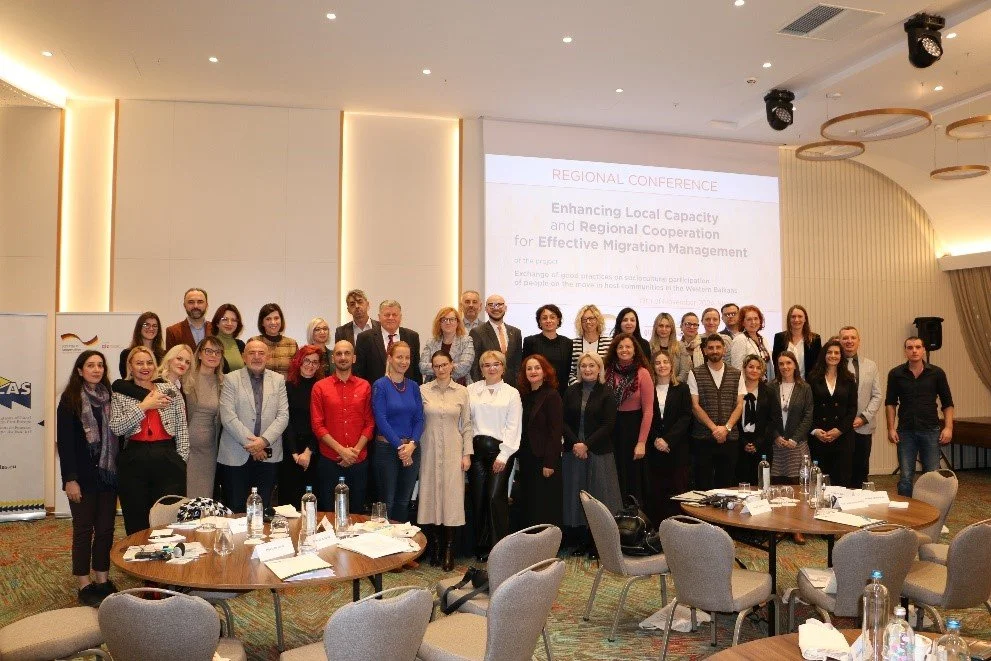
Additionally, NALAS developed and delivered an e-learning course on coordination between host communities and people on the move and conflict transformation. More than 50 representatives from municipalities, local government associations and civil society organisations attended the course. A regional conference further promoted peer learning and networking among stakeholders across SEE.
Moving forward, this action is expected to further institutionalize improved local migration governance across SEE by embedding coordination mechanisms, knowledge products and practical tools within the long‑term work of local governments and their associations.
Integrating the developed recommendations, e‑learning course, and lessons learned into the NALAS Knowledge System will ensure sustained access to capacity‑building resources for municipalities across the region through the frame of the Local Government Associations Training Systems. This will support more consistent, rights‑based and inclusive responses to mixed migration flows, strengthen decentralized cooperation among local authorities, and enhance the ability of municipalities to proactively address social inclusion challenges. Ultimately, the action is expected to contribute to improved service delivery, greater social cohesion between host communities and people on the move, and a stronger, regionally coordinated local government voice in shaping migration governance policies in SEE.
Lessons Learned
Recent initiatives, such as infrastructure development, sports fields, lighting and security measures demonstrate a shift towards more migrant-friendly practices. These efforts contribute to greater awareness and involvement of migrants in social cohesion initiatives, positively impacting local communities.
Continued efforts in strengthening the capacity of personnel directly involved in addressing issues related to people on the move are essential. The positive evaluation of previous training programs indicates the usefulness of such initiatives in improving coordination and handling of diverse challenges.
The importance of strong social infrastructure at the local level is highlighted, suggesting that Local Communities could play a vital role in addressing specific issues and solutions related to migration, contributing to overall community well-being.
Despite progress in project complexity, vertical coordination with higher levels of government has not seen significant improvement. This suggests that efforts should be directed towards enhancing collaboration and communication with governmental bodies to achieve more effective outcomes. Therefore, the role of Local Government Associations is crucial to improving the situation through advocacy actions towards central government institutions.
Priority Objectives

Improving migration governance and forced displacement protection

Protecting those most vulnerable

Eliminating all forms of discrimination and promoting evidence-based public discourse