
Building Communities’ Resilience to Climate Variability in Nyamagabe
Nyamagabe District
Mayor
Hildebrand Niyomwungeri
Start of Project
01/02/2023
End of Project
31/01/2024
© Nyamagabe District
Overview
Nyamagabe District commits to building community resilience and adaptive capacity for people living in Nyamagabe and the nearby Kigeme refugee camp, whose lives and livelihoods are severely impacted by floods, landslides, and droughts.
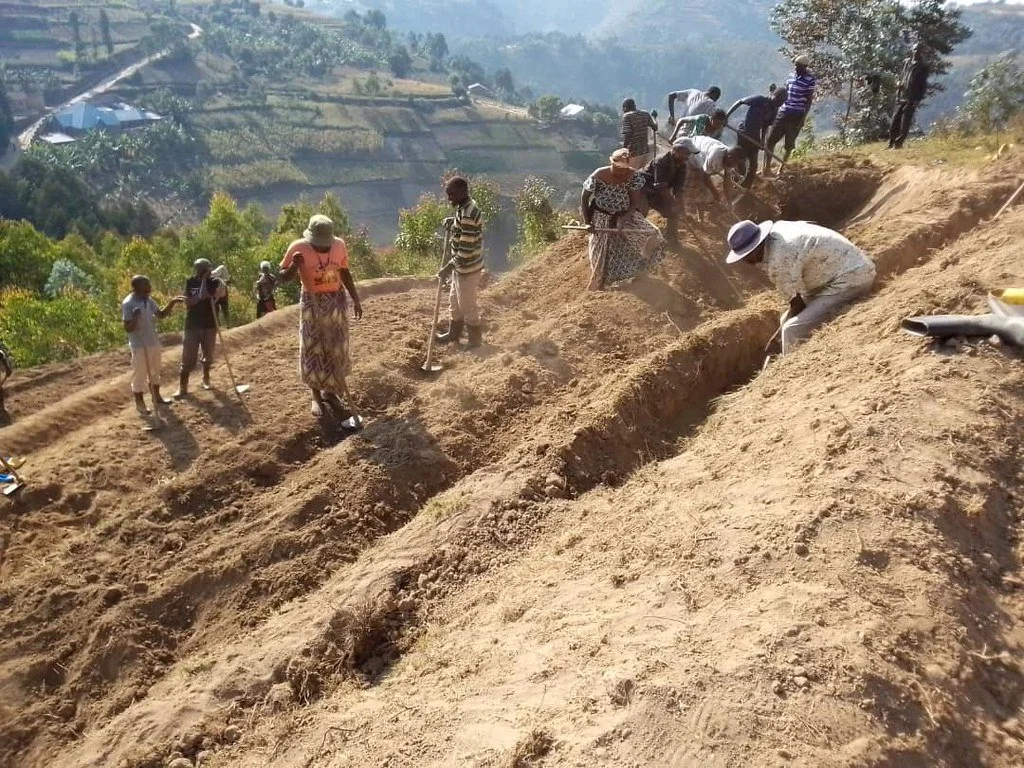
In collaboration with UNHCR Rwanda, Nyamagabe is terracing hillsides prone to landslides into viable agricultural areas, converting waste into renewable energy, and providing basic infrastructure and utilities for additional residential plots.
The project engages 480 individuals from both receiving and refugee communities, involving them in activities such as terracing, plot servicing, waste sorting, and briquette making. These environmentally friendly livelihood opportunities, coupled with training on climate-smart agricultural practices, contribute to enhancing the living conditions of both displaced individuals and Rwandan residents in Nyamagabe, while bolstering food security, improving resettled housing options, and mitigating exposure to natural hazards.
To amplify impacts, Nyamagabe is carrying out awareness campaigns on climate change adaptation and mitigation strategies to support long-term adaptation at the household level. The project creates opportunities for positive interaction between refugees and receiving communities, and serves as a rare example of how camps and towns can support one another towards a green transition. This project is supported by the Global Cities Fund for Migrants and Refugees.
Realised Impact (As of March 2023)
480 people were employed in new green jobs.
Over 100 acres of land were protected from soil erosion through hillside terracing.
Over 300 people were trained in climate adaptation and mitigation practices, including climate-smart agriculture.
250 people in refugee and receiving communities were trained in sorting biodegradable and non-biodegradable waste.
Refugees and receiving community members are collaborating to build an inclusive, sustainable future.
Lessons Learnt
The project underscores the paramount importance of including refugees in employment opportunities. Since its inception, 150 refugees (constituting 44% of all employees) have actively participated in radical and progressive initiatives, including terrace cultivation and nursery preparations. They have collectively contributed 66,800 hours, equivalent to an annual 32 full-time equivalent (FTE). This marks a significant positive milestone for the project.
Furthermore, the project involves various stakeholders, including donors, leaders, and beneficiaries from both refugee and receiving communities. The coordination among these stakeholders has been seamless, resulting in an effective partnership. This collaborative effort has fostered an environment conducive to efficient task delegation.
Priority Objectives

Minimising the drivers of forced displacement, including climate change and environmental drivers

Protecting those most vulnerable

Providing access to urban infrastructure, social services, and education,
regardless of status

Realising socio-economic inclusion

“African cities may be disproportionately impacted by the climate crisis, but we’re also the ones showing the world how to develop innovative, inclusive solutions that make cities more sustainable — environmentally, economically, and socially. The helping hand of the Global Cities Fund for Migrants and Refugees will create jobs for our displaced neighbors, convert waste into greener energy sources, and build vital kinship between Nyamagabe’s refugee camp and its wider community.”