
FAMSI - Diagnostic study: Tú También (You too)
FAMSI—Fondo Andaluz de Municipios para la Solidaridad Internacional
President
Francisco Reyes
Start of Project
06/01/2021
End of Project
08/02/2021
Overview
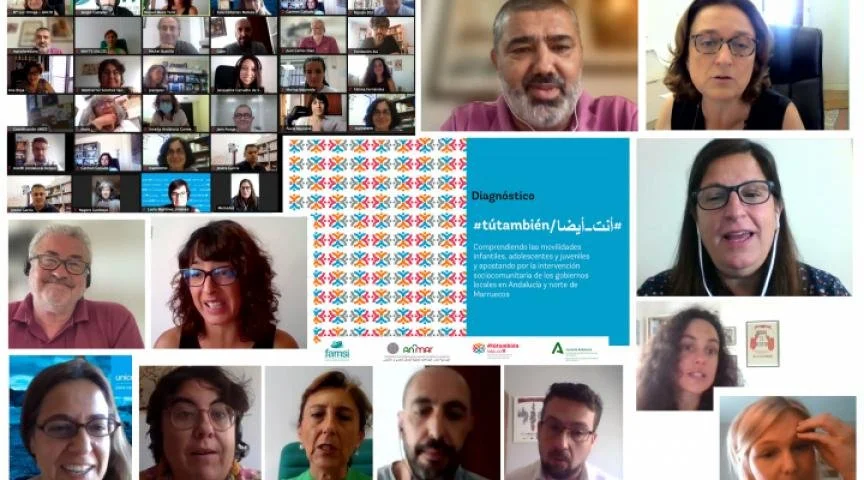
The diagnostic study is part of the #TÚTAMBIÉN / أيضا أنت# project. The document seeks to understand the mobility of children, adolescents and youth by focusing on the socio-community intervention of local governments in Andalusia and northern Morocco; it is part of the project of the same name that seeks to improve inclusion, especially of unaccompanied minor migrants and young people in exile, through education for development, training, exchange of experiences, capacity building and international partnerships.
Forty-two interviews allowed for the reflections of the technical teams of five local governments in Morocco, three in the Tangiers-Tetouan-Al Hoceima region (communes of Martil, Larache and Tetouan) and two in the Oriental region (communes of Nador and Oujda), six municipalities in Andalusia (municipalities of Cádiz, Jerez de la Frontera, Las Cabezas de San Juan, Écija, Seville and Jaén), the Mancomunidad de Municipios del Campo de Gibraltar (province of Cádiz) and the Diputación de Huelva.
With the aim of adding transnational protection mechanisms to the local approach, international entities that play a central role in the promotion of the protection of children, adolescents and young people in migratory processes have also participated in the study. The objective is to articulate actions that place rights at the centre of priorities and overcome xenophobic and racist discourses, with measures to safeguard, protect and defend the rights of children, adolescents and youth.
Expected Impact
The diagnostic analyses the situation of these population groups at origin, and identifies a series of circumstances derived from the systematization of the testimonies provided by local governments, entities and institutions. These include: persistent migratory realities, with a history of over 20 years; there is a need to improve the mechanisms for accessing accurate official figures on the number of minors outside the protection system, contrasting the data from the Register of Unaccompanied Foreign Minors with those of the General Commissariat for Foreigners and Borders; the terminology used to denote these minors does not reflect the diversity of the group.
As opposed to "unaccompanied foreign minors", we propose the perspective of Amina Bargach, psychiatrist and president of the Atlàntida-Marroc Association, who defines children who migrate as "social beings with complex social networks", thus alluding to the socialization processes that take place in the social system of origin and reception.
Lessons Learned
The study advocates for an approach that views the migration process as a whole, incorporating both a transnational perspective and a local focus into the analysis, as opposed to a fragmented perception of its contexts. It is essential not to lose sight of the reality of a highly vulnerable group—comprising children and youth—who nonetheless play an active role in challenging the situations they seek to overcome, such as gender and generational dynamics within families, among others. In other words, a view of the migration process that is motivated, among other reasons, by their own search for resources and goals. Alongside this fact, the assessment notes, their rights cannot be overlooked, due to the clash between the logics of child protection and immigration law, which contradict each other and can lead to situations of institutional abuse. This vulnerability contrasts with the momentum of inclusion projects promoted by local and regional governments.
However, the existing protection is found to be insufficient due to a lack of shelter resources, the absence of a legal framework for guardianship, or the problems with schooling and access to healthcare or residence permits that they face in Morocco. On the Spanish side, the assessment highlights weaknesses such as age determination procedures, a lack of diligence in ensuring immediate school enrollment, delays in providing documentation to the group, and the lack of protection they face upon reaching the age of majority. Among other considerations, the study devotes special attention to the migration of girls—whose numbers have been growing since 2018—who are potential victims of human trafficking networks, on occasion, as well as boys and girls who are exploited for criminal activities.
Priority Objectives

Protecting those most vulnerable

Eliminating all forms of discrimination and promote evidence-based public discourse

Engaging in regional and multilateral partnerships and increasing city-to-city cooperation