
Facilitating Dual Nationality, Preventing Statelessness, and Promoting Inclusion for Foreign-Born Children and their Families in Tlaxcala
State of Tlaxcala
Governor
Lorena Cuellar Cisneros
Start of Project
07/01/2023
End of Project
Open-ended
Overview
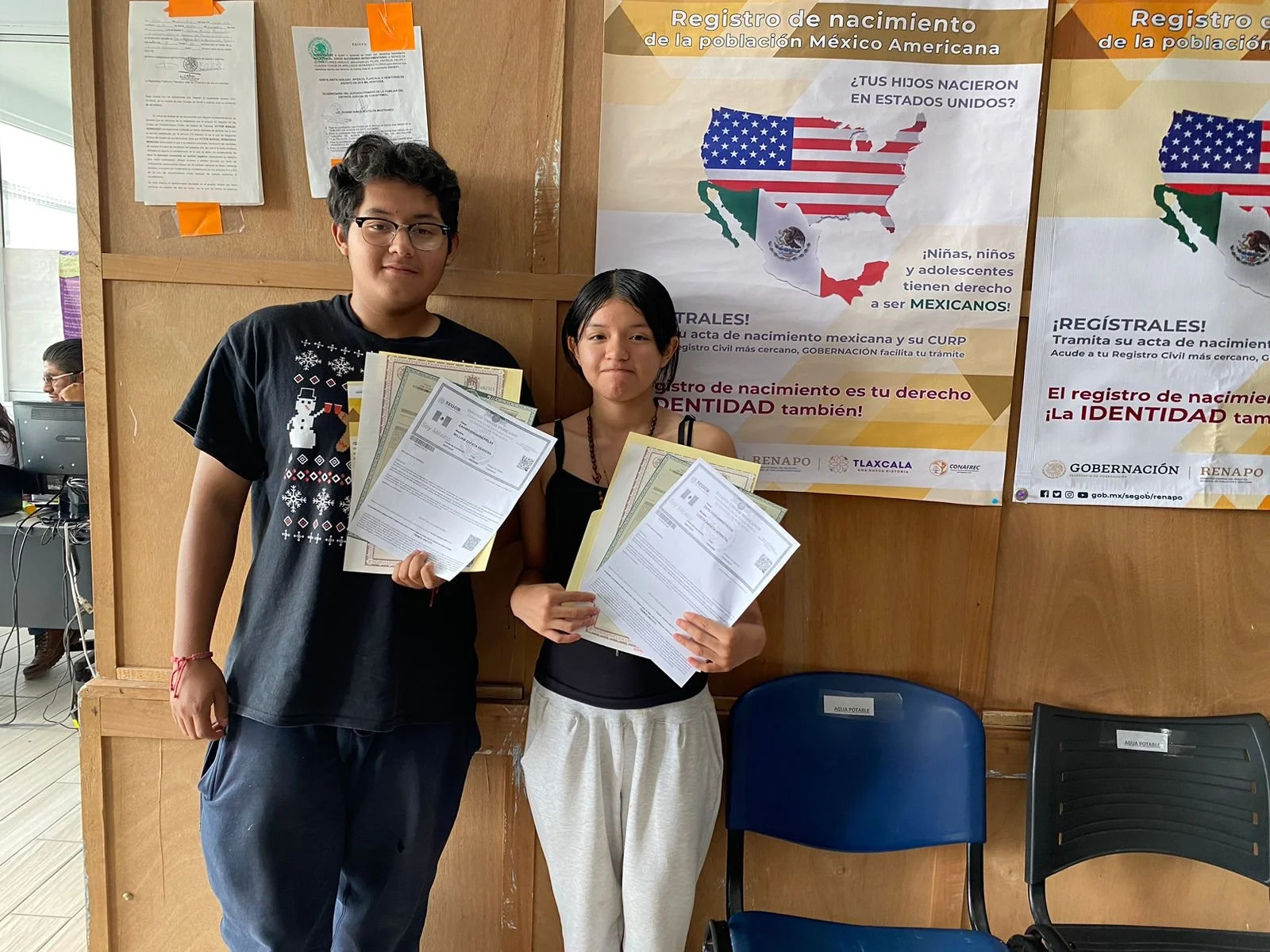
Tlaxcala’s pledge, “Facilitating Dual Nationality, Preventing Statelessness, and Promoting Inclusion for Foreign-Born Children and their Families” (2023–ongoing), is a state policy that eliminates the requirement for an apostilled foreign birth certificate, enabling children born abroad to Mexican parents to access Mexican nationality and identity documents. Implemented by the State Civil Registry in partnership with the Centro de Atención a la Familia Migrante Indígena (CAFAMI), the action benefits migrant and returning/deported families, ensuring children can exercise their rights to education, health, work, and full civic inclusion.
With this policy, the State offers a structural solution that allows effective access to the right to identity for individuals born abroad, which in turn secures access to other fundamental rights such as health, education, work, and housing. It guarantees protection of foreign-born children and also provides an opportunity for returning and deported families to integrate into their communities.
This action represents an effective implementation of the Political Constitution of the United Mexican States (Article 30), which directly grants Mexican nationality to individuals born abroad whose parents were born in Mexican territory or acquired it through naturalization. However, federal entities often impose requirements through their secondary regulations that exceed those required by the Constitution.
This policy now reaffirms the constitutionality of the actions of local governments in civil registry matters and upholds the rights outlined in the Political Constitution of the Free and Sovereign State of Tlaxcala and the Law of the Rights of Girls, Boys, and Adolescents of the State.
The application of basic human rights principles, such as the principle of pro persona and non-discrimination, that of conventionality (reaching the highest standards of human rights protection), and the best interest of the child have been critical to the success of this policy. Likewise, for the first time in the history of Mexico as a sovereign country, a local government (Tlaxcala) will guarantee the rights to identity and nationality for the migrant population.
Expected Impact
To uphold human rights and put an end to "legal non-existence" that makes particularly vulnerable the sons and daughters of migrant families who return to the state voluntarily or forcibly, who will now be able to exercise their constitutional rights as Mexican citizens, by having the birth certificate and the certificate that accredits their Mexican nationality.
Reported Impact [as of November 2025]
Key results include monthly information and documentation clinics, interagency coordination between the Civil Registry and the Education Secretariat, and early evidence that children and youth are successfully obtaining nationality documents and advancing their integration. The main challenges include low awareness of the programme among returning families and limited institutional familiarity with the new legal procedures, requiring expanded outreach and ongoing training for frontline authorities.
Priority Objectives

Improving migration governance and forced displacement protection

Protecting those most vulnerable

Providing access to urban infrastructure, social services, and education regardless of status

Realising socio-economic inclusion