
ANVITA’s ODDyssey Project: Migration Makes the World Go Round!
ANVITA (L’Association Nationale
des Villes et Territoires Accueillants)
Co-Chairs
Damien Carême and Jeanne Barseghian
Start of Project
01/01/2020
End of Project
12/31/2024
Overview
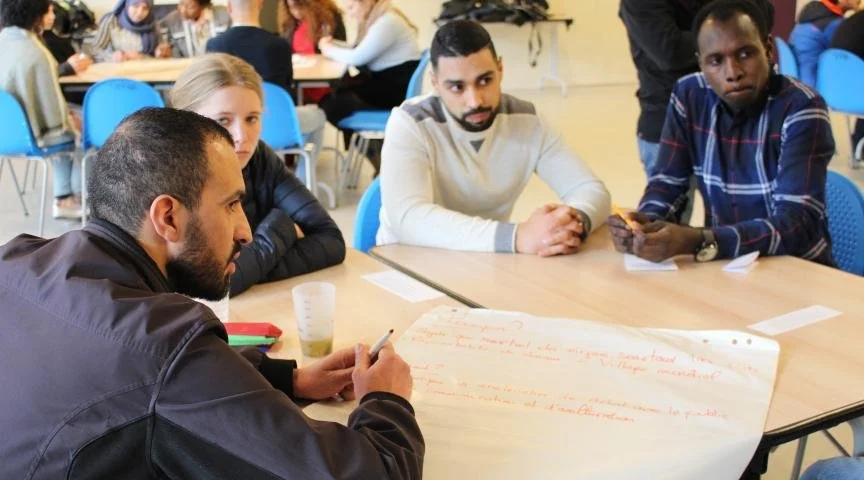
"ODDyssée, migration makes the world go round" is an educational project on citizenship and international solidarity (ECSI), which aims to strengthen the skills of educational actors, associations and local elected representatives in terms of animation and awareness-raising on the link between migratory flows and sustainable development issues through training sessions and workshops. Moreover, through two financial support mechanisms (the "J'M Prize" and the "OSIM Helping Hand"), it aims to support ECSI initiatives carried out by youth actors and/or those with a migration background. Finally, the territorial, multi-scalar and multi-actor approach of this project aims at a change in terms of public actions around "living together", "social cohesion" and local and international "solidarities". The objective of the ODDyssée project is to encourage citizens' openness to the world and to the "Other" and their appropriation of global development issues by promoting the positive contributions of migration "here" and "there". ODDyssée is built on 4 main axes Raising awareness among educational actors and young people through actions articulating 'ODD (SDGs) and Migration' to enable them to carry out actions of Education for Citizenship and International Solidarity (ECSI). To accompany local elected officials around the issues of 'Migration and Development' in several pilot territories in order to promote local and international solidarity initiatives. To create links between young people, educational actors, associations, local elected officials and researchers in order to better integrate them into existing initiatives that aim to promote an informed and reasoned discourse on migration.
Expected Impact
Young people are sensitized and trained on migration issues and educational and social actors carry out ECSI actions around the SDGs.
A framework for reflection and action on migration is put in place for local elected officials and local authority staff to work on the interdependencies between local and international solidarity initiatives (SDGs).
The actors involved in the project - including young people and elected representatives - are valued, their networking is encouraged and the capitalised actions are widely disseminated.
Lessons Learned
The LiBri project has shed light on realities and challenges specific to libraries:
The surveys showed that people seek out libraries as quiet, safe spaces—beyond their role as repositories of knowledge—which requires appropriate facilities (relaxation areas, signage, etc.). Access to basic services (restrooms, Wi-Fi) is often one of the first points of entry for attracting the public.
Hospitality begins with listening, familiarity, and the sense of legitimacy to cross the threshold, long before the library’s collection is even considered.
Libraries serve as catalytic spaces for creating and strengthening social bonds among residents, both long-time and new.
In a context where French language proficiency requirements for obtaining residency permits and citizenship are increasing, libraries serve as key spaces within the local language learning ecosystem.
Involving people in migration situations is essential for creating services that are truly tailored to their needs (hours, collections, activities).
Some media libraries that have opted for a “paperless” approach for environmental reasons have found that users need physical materials (guides, maps) to find their way around, highlighting the need for hybrid tools to avoid widening the digital divide.
Priority Objectives

Improve migration governance and forced displacement protection

Eliminating all forms of discrimination and promoting evidence-based public discourse

Engaging in regional and multilateral partnerships and increasing city-to-city cooperation