
Santiago de Cali Facilitates Connections at the Transport Terminal
Santiago de Cali
Mayor
Alejandro Eder Garcés
Start of Project
01/01/2024
End of Project
12/31/2026
Overview
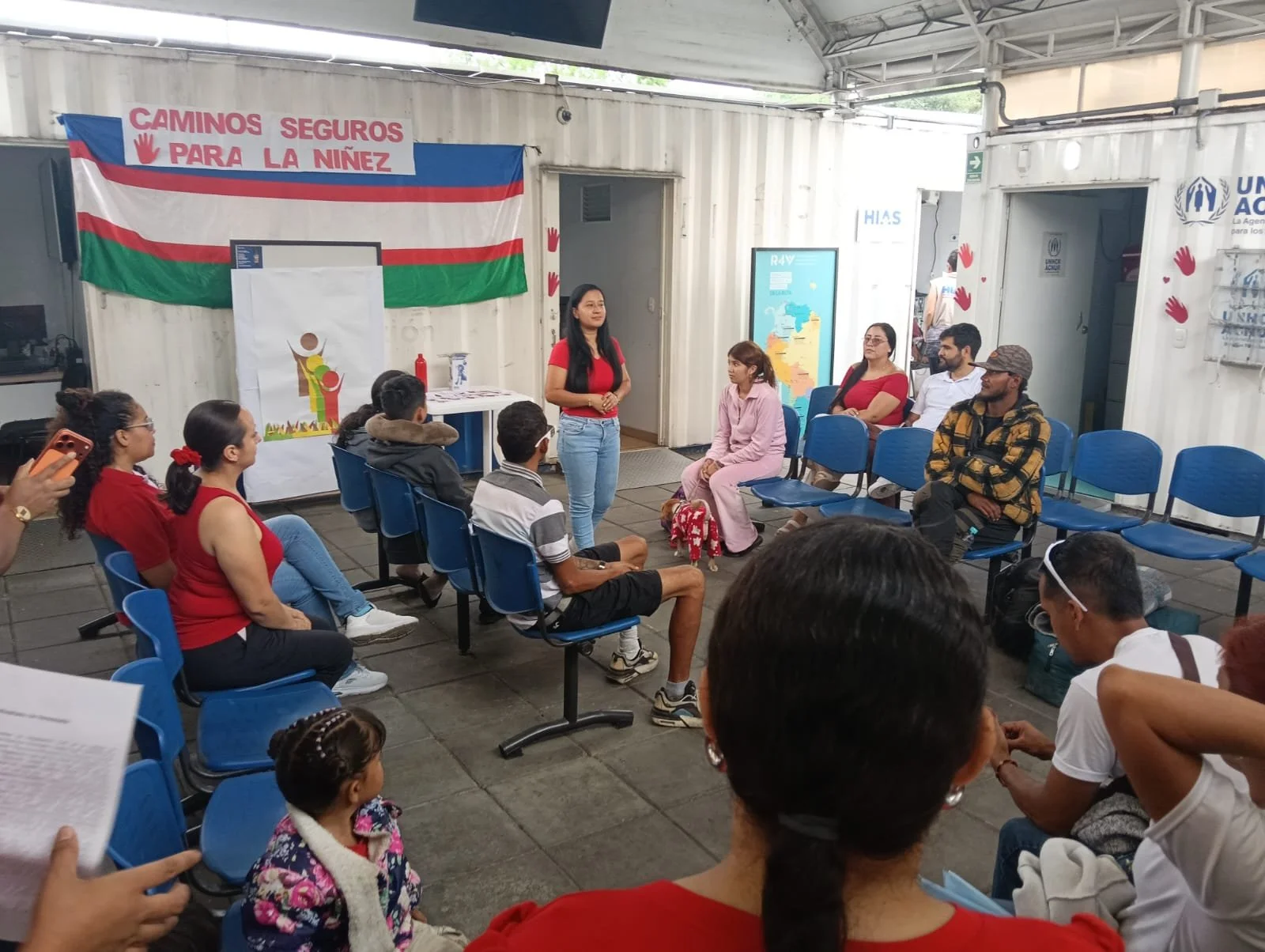
Santiago de Cali commits to continuing implementation of the Support Centre at the Transportation Terminal, a strategic support initiative aimed at migrants in transit along the Pan-American Highway corridor. It is designed as a humanitarian first-response hub that provides guidance, verifies rights, and refers individuals to institutional channels and humanitarian actors at a location with high migrant traffic. Its main objective is to reduce protection risks associated with irregular transit, such as misinformation, human trafficking and smuggling, and family separation, through timely and coordinated assistance. It also seeks to strengthen inter-institutional coordination, facilitating effective referrals to competent entities such as the Ombudsman’s Office, Migración Colombia, ICBF, and humanitarian organizations. As a result, the Space improves local response capacity, optimizes the identification of needs, and helps ensure access to rights for the migrant population in transit. This practice aligns with Goals 7 and 8 of the Global Compact for Safe, Orderly, and Regular Migration (GCM), as well as with the protection approaches of the Global Compact on Refugees (GCR).
Expected Impact
The intended and achieved impact of the Support Space at the Transportation Terminal focuses on effectively reducing protection risks and strengthening the institutional response to transit migration at a critical point along the Pan-American Highway corridor. In terms of protection, the initiative has helped reduce migrants’ exposure to risks such as misinformation, human trafficking and smuggling, and family separation by providing reliable information, immediate guidance, and basic verification of rights. This enables individuals to make informed decisions and access protection mechanisms in a timely manner. At the institutional level, the Space has had a significant impact on inter-institutional coordination, establishing itself as an operational hub that facilitates swift and effective referrals to competent entities (such as the Ombudsman’s Office, Migración Colombia, ICBF, and humanitarian organizations). This translates into a faster, more coordinated, and rights-centered response, especially in contexts of high mobility and pressure on local services. Additionally, the Ombudsman’s Office’s recognition of the Support Space as a key point for verifying rights within the humanitarian pathway demonstrates its value as a best practice that can be replicated in other regions.
Lessons Learned
Positive lessons: First, it has been confirmed that a strategic location at a high-traffic hub enables timely, high-impact interventions, facilitating early access to information and services. Second, the experience shows that inter-institutional coordination on the ground—with a direct presence or coordination among entities such as the Ombudsman’s Office, Migración Colombia, ICBF, and humanitarian organizations—significantly improves the effectiveness of referrals and reduces response times. Likewise, the implementation of a first-response approach with clear guidance and verification of rights helps empower the migrant population and prevent violations. Finally, institutional recognition of the Support Space validates its potential for replication at other critical points in the country or region.
Negative lessons / challenges: Among the main challenges is the high variability of migration movements, which hinders operational planning and can lead to overload during peak periods. Limitations in human and logistical resources also persist, restricting the coverage and continuity of the service. Additionally, the reliance on inter-institutional coordination means that failures in communication or the unavailability of a particular entity can affect the quality of the response. Finally, there is a clear need to strengthen information and monitoring systems in order to improve case traceability and the measurement of medium-term impact.
Priority Objectives

Improving migration governance and forced displacement protection

Protecting those most vulnerable

Providing access to urban infrastructure, social services and education regardless of status

“Migration should be viewed as a driver of development, and [Santiago de] Cali has made significant contributions toward economic inclusion, strengthening the social fabric, and building a city that is free of stigma, more just, and more inclusive for all.”