
Automatic Electoral Registry for Migrants and Awareness Raising of Political Rights in Buenos Aires
Autonomous City of Buenos Aires (CABA)
Mayor
Horacio Rodriguez Larreta
Start of Project
01/01/2022
End of Project
October 2025
Overview
In 2022, the General Directorate of Political and Electoral Reform of the Government of the Autonomous City of Buenos Aires (CABA) launched a ‘Migrant Electoral Guide’, in collaboration with IOM Argentina and UNDP. The guide, available in Spanish, French, Catalan, Guaraní, Chinese, and Korean, is a step-by-step informative tool to promote autonomous participation in local elections and the exercise of political rights for migrants residing in the city.
The guide emerged with the approval in 2018 of the Electoral Code Law No. 6031 of the CABA, which allows foreigners, from 16 years of age, with permanent residence in the City, to vote in local elections without the need for any prior registration.
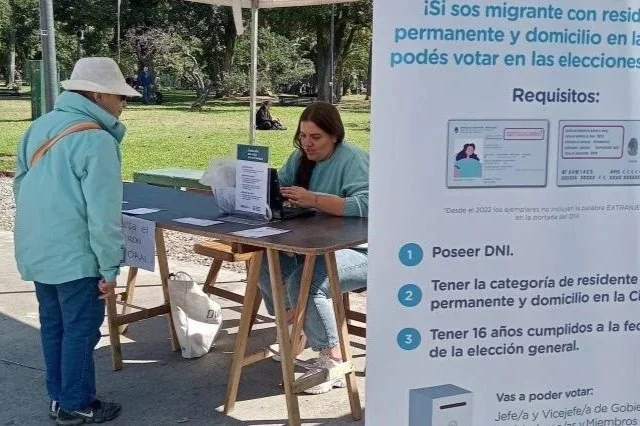
The guide is produced as part of the 'In the City, You Vote' (En la Ciudad, Votás) program, whose objective is to raise awareness about migrants’ voting rights and to encourage their participation.
This ongoing program will offer a range of awareness-raising programs, such as the set-up of ‘Information and Consultation Stands’, located in strategic places within the city. It will also provide the space to train and exchange organizations and community representatives with close ties to the migrant population.
Realized Impact (As of March 2023)
117,056 people were reached directly and indirectly through the Program. This enabled the migrant population’s voting participation to increase by more than 30,000 voters compared to the 2021 electoral process.
Lessons Learnt
The number of migrants who have participated in the elections has increased compared to previous years. Priority was given to being in popular areas where the majority of the community resides, which allowed the city to reach the community in a more direct way, but modified the work dynamics. It was necessary to be more flexible in order to adapt to the new territory, something that was not fully achieved due to a lack of time.
The main lessons learned from the experiences of our trainers in the dissemination and training operations carried out are as follows:
In both polls, the greatest outreach was to older adults. They showed a greater predisposition to establish contact in order to receive the necessary information.
A large percentage of migrants found it difficult to understand the use of the action and were fearful of not being able to vote on their own means.
Even today, there are many migrants who are still unaware of their right to electoral participation.
Migrants express their dissatisfaction due to the lack of dissemination of important dates, such as the date for the claim that allows their incorporation into the electoral roll.
Dissatisfaction due to the lack of knowledge of the automatic registration and for not appearing in the census despite the number of years established in CABA.
Reported Impact [as of June 2026]
The impact of these efforts is reflected in the program’s sustained growth: between 2024 and 2025, the program reached more than 117,000 migrants in the city.
In addition to in-person workshops, based on surveys conducted at the Information and Consultation Desks, we have begun offering the “Migrant Workshop”—virtual sessions with small groups designed to address specific concerns the public may have regarding immigration procedures and questions about access to voting rights.
Priority Objectives

Eliminating all forms of discrimination and promote evidence-based public discourse

Providing access to urban infrastructure, social services, and education,
regardless of status